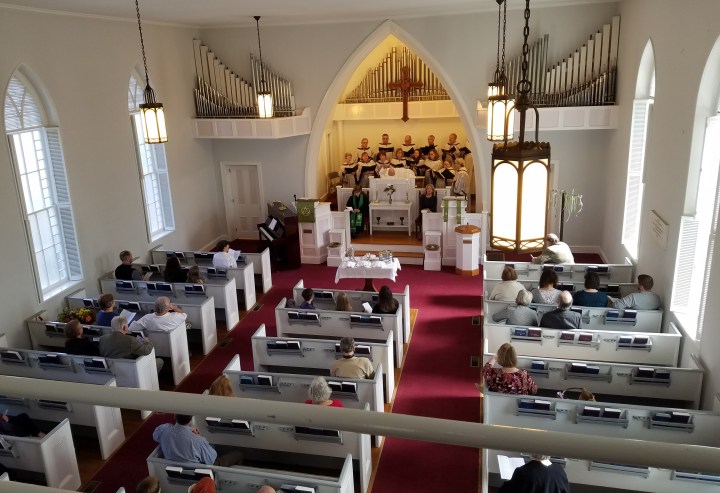
 Yesterday morning in celebration of All Saints Day at the historic Presbyterian church where Alice and I attend, I read excerpts from John Donne’s 17th century meditation from the church balcony.
The reading began: “The church is catholic, universal, so are all her actions; all that she does belongs to all.” And it ended, of course, with: “Any[one’s] death diminishes me, because I am involved in [hu]mankind, and therefore never send to know for whom the bell tolls; it tolls for thee.”
The pastor had cleaned up Donne’s gender-specific language. Still, as I sat in that same balcony where slaves such as Elizabeth Keckley sat in the mid-19th century and where “free” Blacks would have been expected to sit well into the second half of the 20th century, I couldn’t help but wonder what they might have thought if they had heard Donne’s words.
The church is catholic, universal, so are all her actions. And all that she does belongs to all. Really? Elizabeth Keckley, who later went on to buy her freedom and eventually move to Washington D.C. then become Mary Lincoln’s dressmaker and eventually write and publish her own life’s story, was owned, beaten, and occasionally loaned out to other white men for “services” by the Rev. Robert Burwell, the pastor of the very church I was in. What might she have thought had she heard Donne’s altruistic but, for her, hollow words?
Or what might she have thought sitting in that balcony had she heard the ending of the meditation: Any man’s death diminishes me, because I am involved in mankind, and therefore never send to know for whom the bell tolls; it tolls for thee. How might Elizabeth Keckley ever have become more “diminished” than she already was by anyone’s death save her own?
Conversely, it was death, the death of a way of life and thinking in this country, one that somehow justified slavery and the dominance of certain beings over other beings, and the death of more Americans in a war more horrible than any other that gave Ms. Keckley expanded and enlarged life or at least the hope for it. Wasn’t it?
Still, as I sat in that balcony yesterday morning, I couldn’t help but also think, would that it were true. Because it isn’t.
In a way that is very much real, there are still Elizabeth Keckleys who must sit at least symbolically in the balconies of our worlds, even our churches, listening to the bedazzling words of those more powerful or their pundits. Blacks are still expected to sit in such places, if you think about it. So are women and homosexuals, and people of other colors and races than white, and the learning disabled, emotionally fragile, undereducated, impoverished, otherwise disadvantaged, and all the rest who simply cannot become more “diminished” than they already are by anyone’s death, even their own.
So, please, let’s not ever read or recite John Donne to the poor or powerless of the world ever! Talk of them being diminished even more by anything is a crock if not plain silly.
Rather, let’s speak it only to the rich and powerful, which by and large was the case with the mainline congregation in whose balcony I was sitting yesterday, come to think of it.
It’s the rich and powerful — us — who need to hear Donne’s words. Because for sure it is they — us, rather — who are diminished by the death or continued suffering of even just one of the poor or powerless of our world. Because they are the [hu]mankind that we are involved with, like it or not. They can never be diminished, but we certainly can be if we don’t get about the tasks of loving and caring that the preacher talked about in her sermon.
Amen.
 bernieblogdotcom1