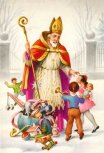

Nathan Leslie, the pastor of my hometown church in western Pennsylvania (Bessemer Presbyterian) published a thoughtful and helpful essay in the congregation’s December newsletter about the origins of the seriously-over-the-top consumerism we Americans experience this time of year. Thought you might appreciate what Nathan had to say too:
As much as Santa Claus has become the poster child, and even idol on the altar of, of American consumerism at Christmas, there is a growing sense among Christians that we need to recover the original St. Nicholas. The true Nicholas was a Christian pastor and bishop, who is the ultimate example of humility, sacrifice, generosity, Christian faith and deep love for the underprivileged, especially children. It’s for this reason that Santa Clause exists today.
Unfortunately, this godly man has been lost now to the conglomerate “Santa Claus” that exists because of Clement Clarke Moore’s A Visit of St. Nicholas, (“Twas the night before Christmas… “) and an early 20th century Coca Cola advertising campaign. He has now been turned into something of the pagan figure of Christmas, a symbol (idol?) of American consumerist culture and often placed at odds with the Christian holy day that celebrates the birth of Jesus Christ. Yet there is a growing sense in the church that if we actually recaptured the image of the true St. Nicholas, it may be for us a gateway of returning Christmas to its true meaning – love and good deeds done because of God’s gift of us in Christ.
You see, the real Santa Claus was born “Nicholas” on March 15, A.D. 270 in the village of Patara, which is on the southern coast of what is now Turkey. His parents were wealthy individuals who raised Nicholas to be a devout Christian, and his uncle was even a bishop. Nicholas’ parents tragically died in an epidemic while Nicholas was still quite young. Obeying Jesus’ words to “sell what you own and give the money to the poor,” Nicholas became convinced to use his whole inheritance to assist the needy, the sick, and the suffering. He dedicated his life to serving Christ and was made Bishop of the nearby city of Myra while still a young man.
Bishop Nicholas became known throughout the land for his generosity to those in need, his love for children, and his concern for sailors and ships. Under the Roman Emperor Diocletian, who ruthlessly persecuted Christians, Bishop Nicholas suffered for his faith, was exiled and imprisoned. After his release, Nicholas attended the Council of Nicaea in A.D. 325 called to settle major theological disputes in the church. Incidentally, he became very angry at the heretic Arius for denying the divinity of Jesus and even slapped him across the face at one point…yes, that’s what happens to jolly old St. Nicholas when you take the Christ out of Christmas.
Anyway, the bishops had him dismissed for this outburst. He was both divested as a bishop and imprisoned. In jail, one night not long after, he had a dream where Jesus and Mary appeared to him and placed the symbols of his office back upon him – his stole and his mitre (the pointy bishops hat). He was then recognized as a bishop once again. Although he was not at the Council for the completion of the Nicene Creed, he was a vigorous defender of the true faith as expressed in the Nicene Creed that we will recite together before celebrating the Eucharist on Christmas Eve.
Nicholas is most well-known for his generosity to the poor and oppressed. One story tells of how a father was forced to sell his daughters into slavery (and perhaps prostitution) because he could not afford to pay the dowry for them to be married. St. Nicholas secretly went on three separate nights and threw three bags of coins into the house to pay the dowries. One night, the coins were thrown down the chimney and landed in stockings that were drying by the fire (hence, the tradition of Santa bringing gifts down the chimney and placing Christmas stockings by the fire). On the last night, Nicholas was caught by the father, but the father was sworn to secrecy.
On another occasion, when making a pilgrimage to the Holy Land, Nicholas is said to have prayed during a storm that arose while he was at sea. The storm immediately ceased at his prayers, and Nicholas soon became known as a wonder-worker as well. He was also known as a person who cared for children. During times of famine, Nicholas used his money to provide food for starving children and their families. He did all these deeds, and many more, in secret, expecting nothing in return.
Apart from the deeds we know he did while living, legend tells us more. St. Nicholas supposedly saved a child who had been captured and taken into slavery, where he became the King’s cup bearer. St. Nicholas appeared in the middle of the night and lifted the boy and his cup, returning him to his parents. In France, the story is told of three small children who were playing and wandered off until they were lost. They were lured and captured by an evil butcher, who killed the boys. St. Nicholas happens to appear at the butcher’s shop and appeals to God to return them to life and to their families.
Nicholas died December 6, A.D. 343 in Myra and was buried in his cathedral church. The anniversary of his death became a day of celebration, St. Nicholas Day, December 6th. His connection to Christmas, therefore, has to do with the celebration of his feast in the midst of Advent.
I am quite an ardent admirer of Nicholas. His life has taught me the meaning of being a true shepherd and teacher to God’s people as a pastor, the importance of defending the faith, and the imperative to act in generosity toward those in need, especially children. In part it is Nicholas’ example, coupled with the teachings of the Holy Scriptures that inspired me to become a foster parent in recent months.
Nicholas teaches us the true meaning of Christmas. If there were ever a reason to recover the true St. Nicholas from the ways our culture has turned him into the idol of our consumerist lifestyle, it is that we might be better followers of Jesus Christ and teach that same faith to our children – just as Nicholas did. For Nicholas, the focus of this season was not the gifts he gave, but the greatest gift that God has given us – His only Son.
This advent as we prepare to celebrate Christmas when the Word of God took on flesh and became God’s great gift of love to the world, I hope you all, young and old alike, will come to admire this saint of the Christian faith. I hope that in hearing of his life and how it exemplifies the Holy Scriptures, we will be prepared not just to celebrate Christ’s first coming, but prepared for his second coming – not decked with tinsel and lights, food, presents, and all the holly jolly – but decked with charity and love, with good deeds, generosity, kindness, and compassionate justice for the under-privileged.
May God richly bless you and yours this Christmas season in the name of the one “who for us and for our salvation was incarnate of the Holy Spirit and the Virgin Mary, and became truly human” – that is, Jesus Christ, God’s only Son, our Lord.
In Christ’s love and service,
Pastor Nathan
Thank you, Nathan And to all of you: “Happy Christmas to all, and to all a good night!”






 bernieblogdotcom1